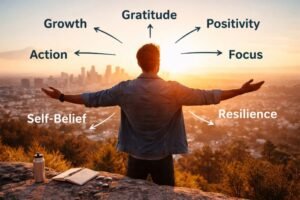







A few years ago, I tried to “reinvent” my entire routine in one weekend. New workout plan. Strict meal prep. Morning journaling. Reading before bed. It felt powerful for about four days. Then real life stepped in, deadlines, errands, low energy, and everything collapsed at once.
That experience taught me something most people learn the hard way: if building better routines feels like a complete lifestyle reset, your brain will fight it. If you want to understand how to build good habits without burning out, you don’t need massive discipline. You need smaller moves. Tiny ones. The kind that slips into your day without triggering resistance.
Why Big Changes Usually Backfire

Behavior science consistently shows that the brain prefers familiarity over ambition. When you attempt dramatic shifts, extreme diets, two-hour gym sessions, and waking up at 5 a.m., your nervous system reads it as stress. Stress leads to avoidance.
That’s why sustainable habit formation is less about motivation and more about systems. Habits form through repetition, not intensity. The habit loop cue, routine, reward wires behaviors into automatic routines over time. The key is lowering the barrier to starting.
If a habit feels easy, you’ll repeat it. If you repeat it, it sticks.
Start Ridiculously Small (Smaller Than You Think)

One of the most effective ways to approach lifelong learning is through micro-habits. These are behaviors so small they feel almost laughable.
One push-up.
One sentence written.
One minute of stretching.
This isn’t about the result. It’s about establishing the ritual.
The Two-Minute Rule works beautifully here. Any new habit should take less than two minutes to start. Want to read more? Read one page. Want to exercise? Put on your sneakers. Want to meditate? Sit quietly for 60 seconds.
Once the action becomes automatic, you can expand it. But expansion comes later. First, protect the start.
Use Habit Stacking To Remove Friction
Most people fail because they try to “find time.” Instead, attach new habits to existing ones.
This is habit stacking using the formula:
After I [current habit], I will [new habit].
For example:
- After I pour my morning coffee, I will take three deep breaths.
- After I brush my teeth, I will floss one tooth.
- After I open my laptop, I will review my task list for one minute.
This works because you’re not creating a new time slot. You’re linking emotional wellness habits. The existing behavior becomes the cue. Over time, the two behaviors merge into one automatic sequence.
That’s how behavior change becomes natural instead of forced.
Design Your Environment, Don’t Rely On Willpower

If you want a habit to stick, make it obvious. Make it visible. Make it easier than the alternative.
Put your workout shoes by the door.
Keep a water bottle on your desk.
Place a book on your pillow.
At the same time, increase friction for habits you want to reduce. Move streaming apps off your home screen. Keep snacks out of sight. Store the remote in another room.
Your environment shapes automatic behavior more than motivation does. When good choices are convenient, consistency becomes easier.
Focus On The Start, Not The Outcome

The biggest mistake people make when learning how to build good habits is obsessing over the end goal.
You don’t wake up fit.
You don’t wake up disciplined.
You don’t wake up productive.
You wake up and perform tiny, repeatable actions.
Research from major universities shows that consistency, not perfection, determines long-term success. Missing one day has no measurable impact. Missing twice begins a new pattern.
That’s where the “Never Miss Twice” principle comes in. Slip-ups happen. What matters is returning immediately. A missed workout is neutral. Two missed workouts start a habit of skipping.
Track Progress To Build Momentum
Tracking works because it visualizes effort. When you mark an “X” on a calendar or log a habit in an app, you see proof of consistency.
You don’t need complex systems. A simple checklist works. Some people prefer apps like Streaks or Habitshare because they gamify progress. The method matters less than the visibility.
Tracking does three important things:
- Reinforces repetition
- Builds confidence
- Creates accountability
Momentum grows when you see evidence that you’re showing up.
Practice Self-Compassion, Not Self-Criticism

Here’s something rarely discussed: harsh self-talk kills consistency.
If every missed day turns into guilt, your brain associates the habit with negative emotion. That weakens the reward loop.
Instead, treat setbacks as data. Ask:
- Was the habit too big?
- Was the cue unclear?
- Did the environment make it hard?
Then adjust.
Experts like James Clear, BJ Fogg, and Charles Duhigg all emphasize the psychology behind habit formation. Celebration, even for tiny wins, wires habits faster. A small mental “good job” strengthens the behavior.
Habits thrive in encouragement, not punishment.
Why Small Wins Compound Over Time
When you improve just 1% daily, change compounds. One push-up becomes five. One page becomes a chapter. One minute becomes a routine.
This is how sustainable routines grow, not through dramatic resets, but through gradual layering.
You don’t need a life overhaul. You need consistency that fits inside your current life.
That’s the real secret behind how to build good habits without burning out.
FAQs
1. How long does it take to build good habits?
It varies. Some behaviors feel automatic in a few weeks, while others take several months. Consistency matters more than a fixed timeline.
2. What is the easiest way to start building good habits?
Start with a two-minute version of the habit. Make it so small that you cannot fail. Establish the ritual first, then increase gradually.
3. Why do I lose motivation after a few days?
Motivation naturally fluctuates. That’s why systems, cues, and environment design work better than relying on willpower.
4. Can I build multiple good habits at once?
You can, but it’s smarter to anchor one or two at a time. Once they feel automatic, add another small layer.
Final Thoughts
If there’s one thing I’ve learned about habit psychology, it’s this: change feels heavy when you try to carry everything at once. But when you shrink the action down to something almost effortless, your resistance fades. Tiny habits create identity shifts. You start seeing yourself as someone who shows up. That identity compounds far more powerfully than any short-term burst of motivation ever could.
Start small. Protect consistency. Expand later.